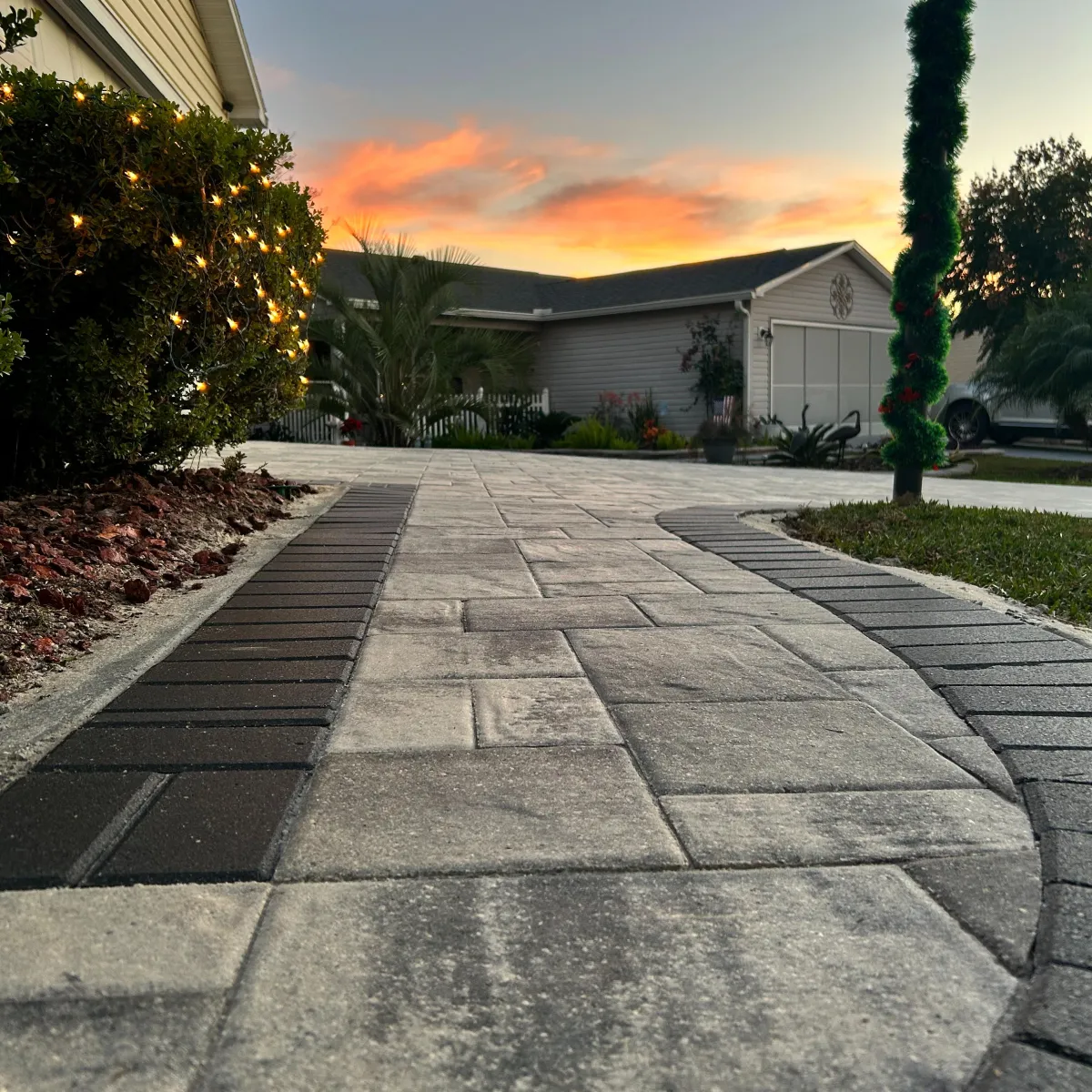
Pavers vs. Concrete: How the Right Choice Raises Your Home's Value
When homeowners in Orlando and Central Florida think about upgrading their driveway, pool deck, or patio, the conversation almost always comes back to the same question: pavers or concrete?
Concrete is cheaper upfront - that much is true. But in Florida's climate, with its heat cycles, heavy rain, shifting sandy soil, and a real estate market where curb appeal genuinely moves sale prices, the upfront cost is rarely the whole story. The right material doesn't just look better, but it holds its value, performs better over time, and comes back to you when you sell.
Here's the full picture.
What we're actually comparing
Both pavers and poured concrete can be used for driveways, patios, pool decks, and walkways. The core difference is structural: concrete is poured as a single continuous slab, while pavers are individual units such as brick, travertine, or concrete installed over a compacted base with sand and joint material between them.
That difference in structure is what drives almost everything else: how they handle Florida's climate, how they age, how easy they are to repair, and how buyers perceive them.
The cost breakdown: what you'll actually pay in 2026
Poured concrete
A standard concrete driveway or patio in Florida typically costs $6 to $12 per square foot installed in 2026, depending on thickness, finish, and site prep. Decorative options, which include stamping, staining, and exposed aggregate, can push this to $15 per square foot. For a standard 600 sq ft driveway, expect $3,600 to $7,200 for plain concrete.
Paver installation
Paver installation in Florida runs $12 to $25 per square foot, depending on the material (concrete pavers on the lower end, travertine and natural stone higher), pattern complexity, and site conditions. For the same 600 sq ft driveway, that's $7,200 to $15,000.
The upfront gap is noticeable but what happens over the next 10 to 20 years is where the comparison really flips.
~100%
ROI reported on paver driveways at resale in Central Florida
50 yrs
Typical lifespan of a properly installed paver system vs. 15-20 yrs for concrete
72%
Of homebuyers say curb appeal influences their purchasing decision
Why Florida is especially hard on concrete
Plain concrete works reasonably well in stable climates. Florida is not a stable climate and that matters more than most homeowners realize when choosing a surface material.
Heat expansion and contraction. Florida's daily temperature swings cause concrete slabs to expand and contract repeatedly. Over time, this creates hairline cracks that widen into full splits requiring costly repairs or full slab replacement.
Sandy, shifting soil. Florida's sandy soil doesn't provide the stable sub-base that concrete needs. As the ground shifts, especially after heavy rain saturates the soil, concrete slabs crack, sink, or heave unevenly.
Heavy rainfall and drainage. A concrete slab has almost no permeability, which means water pools on the surface and runs off in concentrated flows. Over time this erosion undermines the edges and sub-base.
UV bleaching and staining. Florida's year-round sun bleaches and dulls concrete surfaces. Tire marks, oil, and tannin staining from tree roots are notoriously difficult to remove from plain concrete.
Pavers handle all of this better because they're not one rigid slab. Individual units can flex with the ground, water drains through the joints, and a cracked or stained paver can be replaced for a fraction of the cost of patching or replacing a concrete slab.
The real estate case for pavers in Central Florida
Here's what separates the pavers vs. concrete decision from most other home improvement choices: pavers don't just look better, they give you money back.
Real estate professionals in Tampa Bay and Central Florida consistently report near-100% ROI on paver driveways at resale. Meaning the installation cost is largely recovered in the sale price, and homes with pavers sell measurably faster than identical homes with plain concrete.
The reason isn't just aesthetics. Buyers in the Orlando market, especially in neighborhoods like Winter Park, Dr. Phillips, Lake Nona, and Windermere, recognize pavers as a signal of quality maintenance and premium finishes. A paver driveway and pool deck says this home has been cared for properly. A cracked concrete slab says the opposite.
Timing matters
If you're listing your home in the next 60 days, install fresh sod or pressure wash - you won't recoup a paver investment that fast. But if you have 6-12 months before listing, a paver driveway is one of the highest-ROI exterior investments you can make in the Florida market.
Pool decks: where pavers pull even further ahead
The pool deck is where the pavers vs. concrete conversation becomes clearest. Plain concrete around a pool creates several problems that compound over time in Florida:
It gets extremely hot underfoot in direct sun - uncomfortable and unsafe for kids and pets
It's slippery when wet, creating a genuine safety hazard around pools
Pool chemicals, humidity, and constant wet-dry cycles accelerate cracking and staining
When the coping (the edging around the pool shell) deteriorates alongside the deck, the repair becomes a full replacement project
Travertine pavers, the most popular pool deck material in Central Florida, stay cooler than concrete in the same sun, have a naturally slip-resistant surface, drain well, and complement pool coping beautifully. When a homeowner redoes their pool deck in travertine and pairs it with matching coping, the transformation is dramatic and it's exactly what luxury home buyers in this market are looking for.
What about the driveway?
Paver driveways in Florida typically use concrete or brick pavers rather than travertine (which is better suited to pool areas). The interlocking structure means individual units handle daily vehicle weight and heat expansion without the cracking that plagues poured slabs. Most paver driveways in Central Florida are still looking excellent at 20-30 years with periodic resealing, while concrete driveways in the same neighborhoods have often been replaced once or twice.
What pavers can be used for and when each material shines
One of the advantages of pavers that often surprises homeowners is design versatility. Depending on the space and your home's aesthetic, different materials serve different needs:
Travertine - natural stone, cooler underfoot, naturally slip-resistant, beautiful around pools and in upscale outdoor spaces. Highly popular in Winter Park, Dr. Phillips, and Windermere homes.
Brick pavers - durable, classic, excellent for driveways and walkways. Timeless look that suits both traditional and contemporary Florida homes.
Concrete pavers - versatile, cost-effective, available in an enormous range of colors and patterns. The most common choice for driveways and patios.
When concrete still makes sense
We're paver specialists, but we'll be straight with you: there are scenarios where concrete is the practical call.
Tight budget, immediate need. If you need a functional surface now and can't stretch to pavers, concrete gets the job done at lower initial cost.
Large utility areas. For rear utility pads, storage areas, or back-of-property surfaces that won't be seen or used heavily, plain concrete is cost-effective and sufficient.
Very short ownership horizon. If you're selling in the next few months and just need the exterior to look presentable, a concrete patch or pressure wash may be all you need.
Outside of those specific situations, pavers almost always represent the better longterm investment for Central Florida homeowners, particularly when pool decks, driveways, and visible outdoor spaces are involved.
One crew. One project. One result that all matches.
At Smart Solution, we install pavers for driveways, patios, pool decks, and walkways, and we also install the pool coping that frames the water. Combining both in one project means everything matches perfectly, the crew is on site once, and the total project almost always costs less than two separate jobs. Ask us about this when you get your quote.
The bottom line
Concrete is cheaper today. Pavers are worth more over time in durability, in performance in Florida's climate, in repair costs, and in what they return when you sell. For Central Florida homeowners investing in their outdoor space, the right material isn't just about the upfront number. It's about what the yard looks like five years from now, and what a buyer is willing to pay for it.
If you're weighing the decision for your driveway, patio, or pool deck, the best next step is a free consultation. We'll walk your property, show you material samples, and give you an honest quote.
Ready to invest in your home's outdoor space?
We'll visit your property, walk you through material options, and give you a clear, honest quote. No pressure, ever.
📞
Click Here to Book Your Free Consultation!